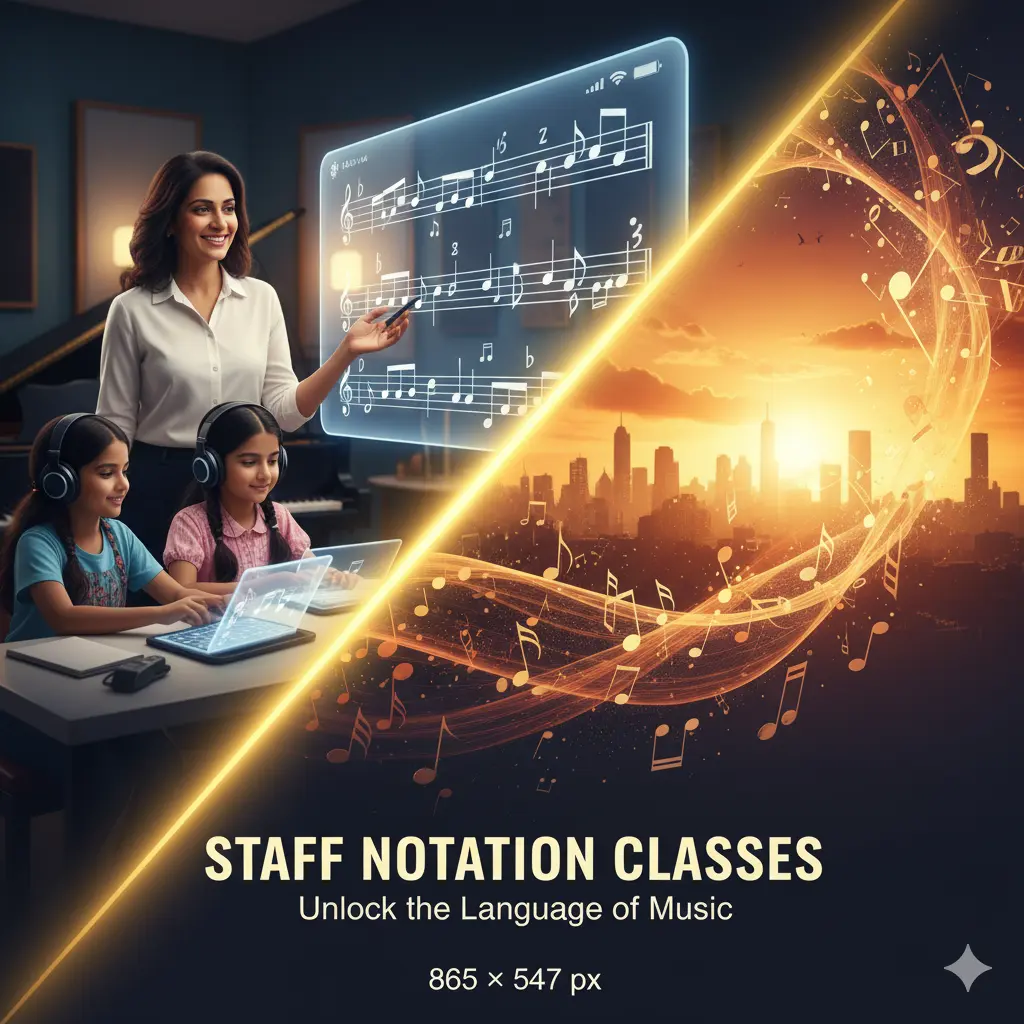
If you’ve ever looked at sheet music and wondered what all those lines, dots, and symbols mean, our staff notation classes are the perfect starting point. Learning to read music gives you a whole new way to understand and connect with melodies. It’s like unlocking a secret musical language that helps you communicate, play, and compose with precision and confidence.
Understanding the Basics of Staff Notation
Before diving deep, let’s start with the basics of staff notation. Staff notation is a system used by musicians worldwide to represent musical sounds through written symbols. The “staff” is made up of five lines and four spaces, each representing a different musical pitch. When you learn to read these notes, you can play any piece of music, no matter the instrument or genre.
In our staff notation classes, students begin by recognizing note values, time signatures, and key symbols. These foundational elements make it easier to interpret rhythm and pitch, helping you play pieces just as they were meant to sound. Think of it as learning to read a new language, one that speaks directly to your musical soul.
Why You Should Learn Staff Notation
When you learn staff notation, you gain the ability to understand music on a deeper level. Instead of memorizing patterns or relying on imitation, you’ll truly grasp how music works, why certain notes sound harmonious together or how rhythm shapes emotion.
Reading notation also builds independence. You’ll be able to pick up a new song, sight-read it, and play confidently without waiting for someone to show you. This skill is essential for anyone who wants to grow as a serious musician, composer, or performer.
Moreover, learning staff notation strengthens your connection between music theory and notation, making it easier to understand scales, chords, and harmony. Once you grasp how everything fits together on the staff, music becomes less mysterious, and far more expressive.
How to Read Music Notes: A Beginner’s Journey
Understanding how to read music notes might feel intimidating at first, but it’s easier than it seems once you get the hang of it. Each note on the staff corresponds to a specific pitch, and the placement of that note tells you how high or low it should sound.
Our teachers at Sonoro Music School guide you through each step of this journey. You’ll start by learning the treble and bass clefs, then move on to rhythm patterns, rests, and dynamics. Gradually, you’ll develop the ability to sight-read entire pieces with accuracy and emotion.
It’s a step-by-step process, and with regular practice, reading music becomes as natural as reading words on a page.
Checkout : singing classes online | online keyboard classes | piano teacher online
Music Theory and Notation: Building a Strong Foundation
To truly master music, you need to understand how music theory and notation work hand in hand. Theory explains why music sounds the way it does, while notation shows how to play it. Together, they form the backbone of every great musician’s training.
Our staff notation classes integrate theory lessons seamlessly. You’ll explore topics like scales, chord progressions, intervals, and rhythm structures, all explained in a way that’s easy to grasp, even if you’re just starting out. By combining practical reading exercises with theoretical understanding, students develop both clarity and creativity in their musical expression.
Join an Online Staff Notation Course
If you’re looking for flexibility, our online staff notation course is a great way to learn at your own pace. Whether you’re a student, working professional, or hobbyist, you can access structured lessons, interactive exercises, and one-on-one guidance from expert instructors, all from the comfort of your home.
These online classes make it easier to revisit concepts, practice regularly, and track your progress over time. Plus, you’ll join a community of learners who share the same passion for understanding the universal language of music.
Master the Art of Reading Music
Every great musician started somewhere, often with a simple line of notes on a page. The ability to read and understand music gives you freedom: freedom to play new pieces, compose your own melodies, and express your emotions through sound.
Through staff notation classes at Sonoro Music School, you’ll learn to see music differently, not just as sound, but as structure, story, and art. Whether you dream of performing, teaching, or composing, this skill will stay with you for a lifetime.
So pick up your instrument, open your sheet music, and take that first step toward becoming fluent in the language of music.
Frequently Asked Questions
1. What will I learn in staff notation classes?
In staff notation classes, you’ll learn how to read and write musical notes, understand rhythm and tempo, and interpret symbols used in sheet music. It’s the foundation for all musical instruments.
2. Why should I learn staff notation instead of playing by ear?
When you learn staff notation, you gain the ability to read, play, and compose any piece of music accurately. It helps you understand structure, harmony, and rhythm, making you a more skilled musician.
3. Is it necessary to study music theory and notation together?
Yes! Music theory and notation go hand in hand. Theory explains why music sounds a certain way, while notation shows how to play it. Learning both strengthens your overall musical understanding.
4. What are the basics of staff notation I should know first?
The basics of staff notation include learning the staff lines, clefs, note names, key signatures, and time values. Once you master these, reading music becomes much easier.
5. Can I take an online staff notation course to learn how to read music notes?
Absolutely! Our online staff notation course helps beginners learn how to read music notes step by step, with guided lessons, interactive exercises, and instructor support, all from home.